
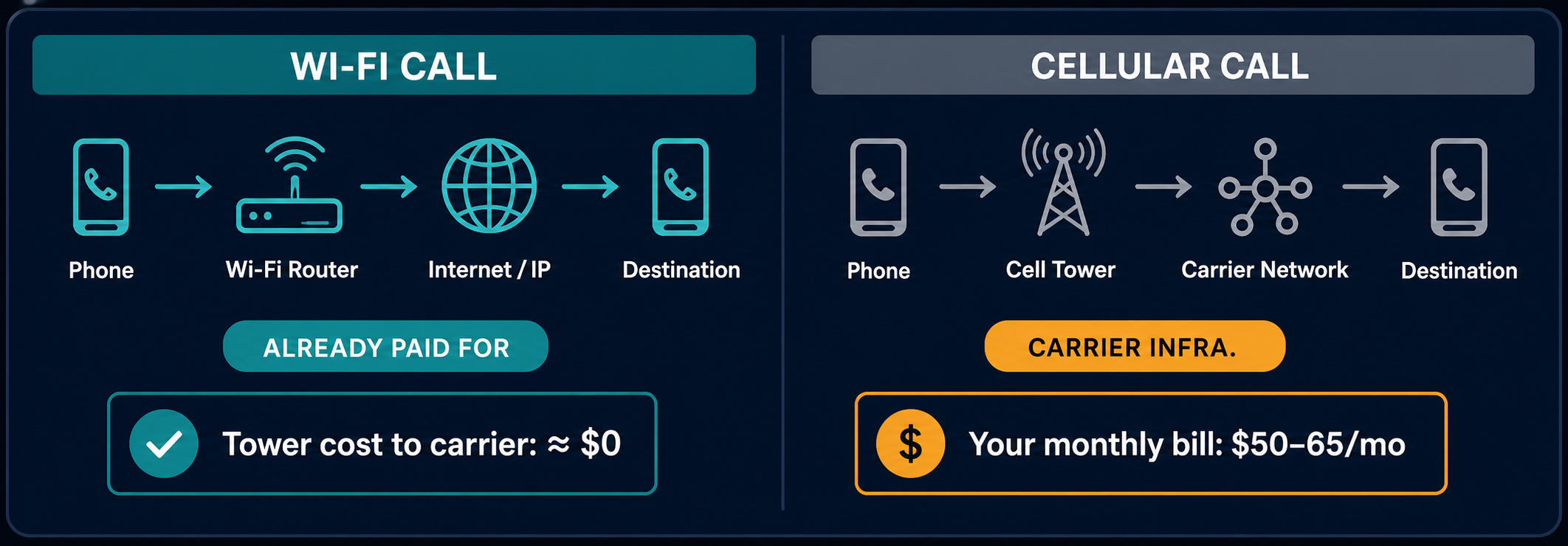
Yes — provided by your carrier, as part of your cellular subscription. What the complaint alleges does not exist is a Wi-Fi-primary service you can buy from an independent provider: one that works as your ordinary primary line, uses your regular number, rings normally, appears in your call history and handles emergency calling, without also requiring you to buy conventional cellular service.
An app can carry a call over Wi-Fi, assign a number, reach the phone network and bill a customer. What it cannot obtain, according to the complaint, is native handset treatment: the default dialer, ordinary inbound ringing, the integrated emergency calling workflow, native call history, and continuity between Wi-Fi and cellular. Those functions are gated behind carrier credentials and platform permissions that non-carriers have no ordinary pathway to obtain.
It can. That's the point.
When you port a number from one carrier to another, the receiving carrier re-provisions its own credentials and your native calling continues without interruption. When you port to a non-carrier, the number moves but the credentials, registration, configuration and Wi-Fi Calling entitlement do not, and the subscriber loses native integration.
The number is portable. The native telephony features are not.
The complaint alleges it is a choice. Under the EU's Digital Markets Act, Apple opened APIs that let eligible third-party apps act as the default cellular dialer and handle carrier SMS, MMS and RCS messaging. Apple withholds that integration in the United States.
The complaint also cites changes Google made to Android at carriers' request, including a February 2015 change T-Mobile asked for. Carriers can get the handset behavior they want. Independent providers have no equivalent channel.
VoIP-Pal seeks damages and an injunction barring the carriers from conditioning native telephony on carrier affiliation. If it obtains that relief, it alleges independent providers could offer Wi-Fi-primary service directly to consumers, as several companies did before 2020. Digifonica priced a comparable service at about $6.50 a month, and VoIP-Pal states it is prepared to enter the market itself.
Litigation outcomes are uncertain, and nothing here has been decided by a court.
Third Amended Complaint ¶154, p. 45 · ¶¶184–186, pp. 49–50 · ¶220, p. 57